From scarcity to stewardship
Where should we spend our time?
As AI and robotics take over more of the work required to keep society running, humanity faces a real question: if we don’t have to spend most of our lives just securing survival, what should we live for?
Crossover explores that shift—from an existence organized mainly around ourselves toward conscious stewardship of the living world. And it begins with something ordinary.
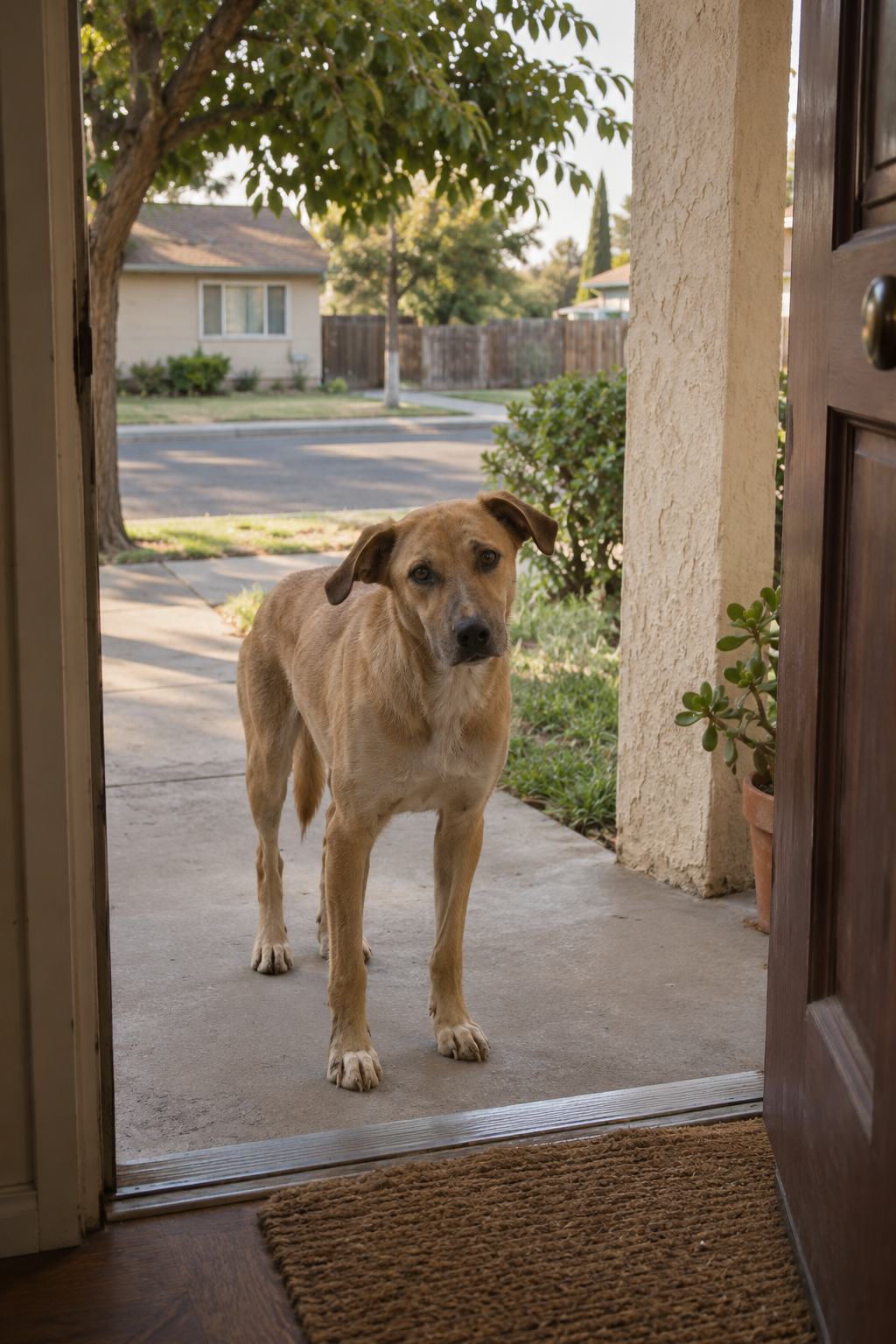
The Animal Outside the Door
Wanting to help is simpler than knowing how.
Most of the time, we’re absorbed in our own lives—our responsibilities, security, possessions, relationships, and plans. An animal outside the door may barely register.
Crossover calls this unconsciousness: living largely through evolutionary conditioning, experiencing the world mainly in relation to ourselves. That isn’t a judgment about good or bad people. It’s a condition we can all recognize.
Then something shifts. You notice another living creature, recognize that its life matters on its own terms, and want to help. Immediately, real-world complexity opens up:
What actually happens next?
- Should you feed the animal, or does it belong to a neighbor?
- Is it already receiving care? Will feeding attract more animals?
- What about neighbors, reproduction, disease, and native wildlife?
The scale of the problem
One doorstep connects to millions of lives.
Across the United States, millions of dogs and cats live in the gap between human goodwill and functioning care systems.
Sources: HumanePro and Shelter Animals Count 2025 report.
Planetary stewardship in miniature
The Ripon dilemma
In nearby Ripon, California, the City Council voted in November 2026 to restrict feeding stray and feral cats on public property without written authorization.
CBS News Sacramento report on the Ripon vote (Nov 2026). Watch on YouTube · City of Ripon meeting records.
Why residents feed
People see hungry animals in front of them and want to prevent suffering. Leaving an animal to starve feels wrong when food is right in the kitchen.
Why others worry
Unplanned feeding can concentrate unsterilized cats, increase sanitation and neighborhood friction, spread disease, and put pressure on local wildlife.
What Crossover asks instead
We don’t ask you to pick a side. We ask: what is actually happening, and what system would best care for the cats, the wildlife, and the community?
The crossover, from me to us
Three hopes as machines take on routine work
Technology alone doesn’t decide what we live for. As AI and robotics replace more human labor, Crossover is built around three simple hopes:
More people will become conscious—less trapped in fear, status, and self-centered stories.
They will have more time to care about reality and the living world around them.
Technology will be able to help them actually deliver that care.
That is the crossover: from me to us. From happiness as disconnection from reality and suffering into private wealth, to happiness as connection to reality and stewardship.
Returning to the central question
Where should we spend our time?
Not because recreation, beauty, or personal freedom lack value—they are part of life. But because post-scarcity gives us the chance to ask what actually needs doing in the world, starting right where we live.